
What Does 'Cleave' Mean in Genesis 2:24? And Why It Still Matters for Your Marriage
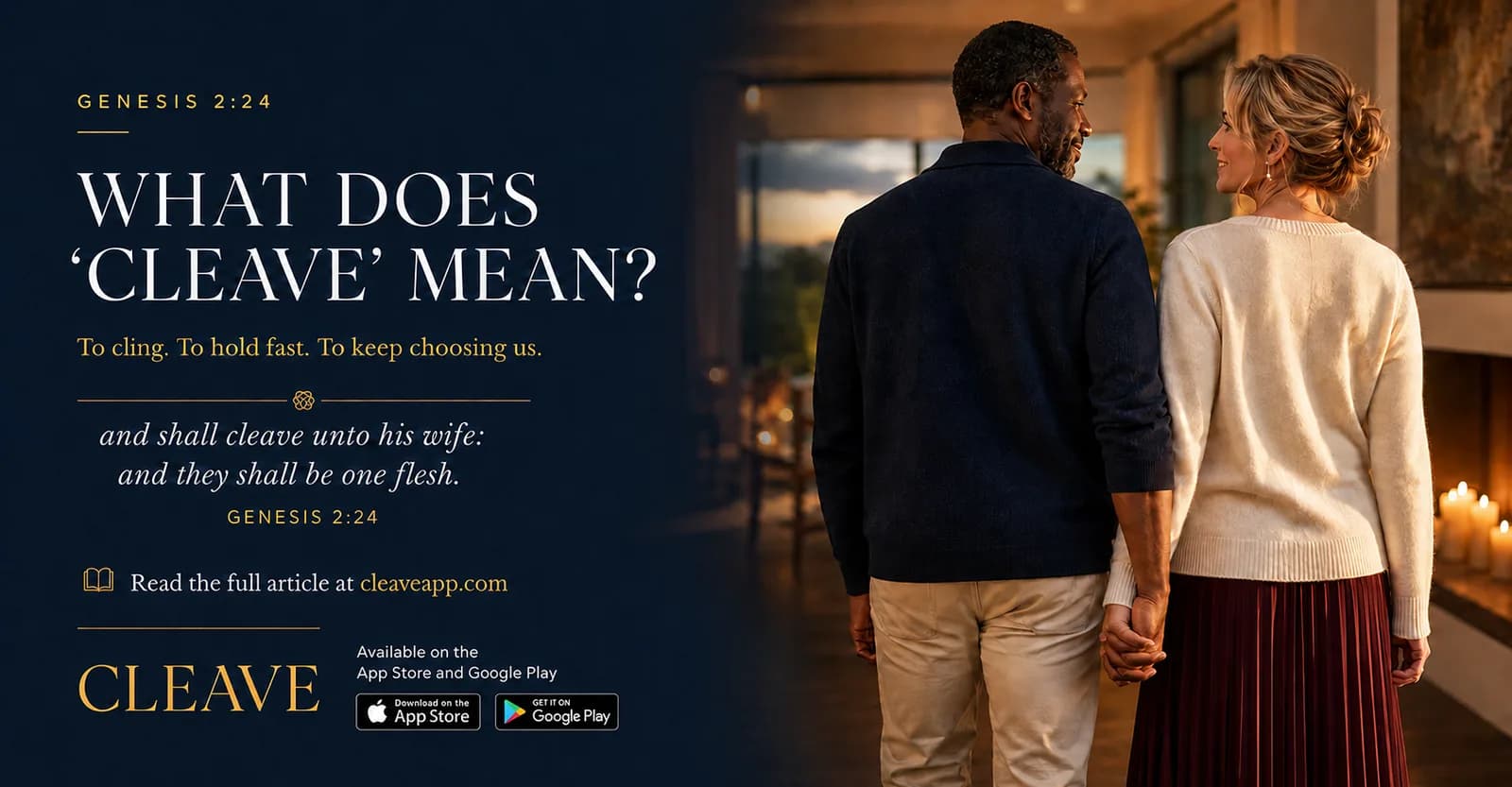
If you have ever read Genesis 2:24 in an older Bible and paused at that unusual word, you are not alone. So what does “cleave” mean in Genesis 2:24? In short, it means to cling, to stick fast, to be joined so closely that you will not easily be pulled apart. It is one of the most tender and demanding words in Scripture about marriage — and it is worth understanding, because it quietly shapes how two people stay close across a lifetime.
What does “cleave” mean in Genesis 2:24?
The verse reads, in the King James Version: “Therefore shall a man leave his father and his mother, and shall cleave unto his wife: and they shall be one flesh.” Newer translations often render the same word as “hold fast” (ESV) or “be united to” (NIV). They are all reaching for the same idea.
The Hebrew word behind “cleave” is dabaq. It is a physical, almost stubborn word. It is used elsewhere in the Old Testament for skin clinging to bone, for a belt clinging to the waist, and for Ruth clinging to Naomi when everyone expected her to walk away. To cleave is not a soft, sentimental feeling. It is a decision to stay attached — to keep holding on, on the ordinary days and the hard ones.
“Leave” comes first
It is easy to miss that the verse begins with leaving. Before a man cleaves to his wife, he leaves his father and mother. Marriage asks for a real shift of loyalty and attention — away from old homes, old habits and even good relationships that used to come first. You cannot cleave to your spouse with your whole self while half of you is still anchored somewhere else. Leaving and cleaving are two halves of one movement.
To cleave is to cling on purpose
Because dabaq is so physical, it teaches us that closeness in marriage is not mainly about how we feel on a given morning. Feelings drift. Cleaving is what you do when the first rush has quietened and life gets busy: you choose, again, to turn toward this person. That is why so many couples who love each other still end up feeling more like flatmates than soulmates. They never stopped loving. They just slowly stopped clinging — stopped closing the small gaps as they opened.
Why “cleave” still matters for your marriage
Understanding what cleave means in Genesis 2:24 is not a history lesson. It is a picture of the kind of marriage most of us actually want: two people who stay attached on purpose, who keep choosing each other. The good news is that clinging is not one grand gesture. It is built out of very small, repeated turns toward one another — a question asked, a hand held, a moment of honesty offered when it would be easier to stay silent.
None of this is about performing a perfect Christian marriage. It is about the quiet, daily habit of holding fast. And that habit can be rebuilt, even after a long season of drift.
Four small ways to cleave this week
You do not need a weekend away or a new programme to begin. Try one of these, starting today.
1. Ask one real question a day
Most couples talk logistics — the school run, the bills, who is cooking. Cleaving grows in the deeper conversations. Ask something you do not already know the answer to: “What has been weighing on you this week?” or “When did you last feel really close to me?” Then listen without fixing.
2. Close the small gaps quickly
The distance in a marriage is rarely one big rupture. It is a hundred tiny moments left unaddressed. When something stings, name it gently and soon — the same day if you can — rather than filing it away. Small repairs keep you clinging.
3. Turn toward, not away, after friction
The moments right after a disagreement are where marriages quietly grow closer or slowly drift apart. Instead of retreating into separate rooms and separate silences, make the first small move back: a softer tone, a hand on the shoulder, “I don’t want to stay stuck in this.”
4. Pray, even briefly, together
You do not need eloquent words. A shared sentence — “Lord, help us hold fast to each other” — invites God into the ordinary work of cleaving. This is the third strand that steadies the two.
If a daily rhythm like this is hard to keep up on your own, a tool like Cleave can carry the structure for you. It is a free Christian marriage app built around exactly these small habits — a daily question, gentle repair tools for the moment right after an argument, and space to grow closer in about five minutes a day.
When cleaving feels hard
For some couples, holding fast feels almost impossible right now. There may be old hurts, exhaustion, or a distance that has grown for years. If that is you, be gentle with yourself. Cleaving is a direction, not a single leap — and beginning again is always allowed. Even Ruth’s clinging began with one decision to stay.
Start small. Choose one turn toward your spouse today, and another tomorrow. Over time, small choices become the strong, stubborn, dabaq kind of closeness that Genesis 2:24 describes.
If you would like a simple, faith-rooted way to practise these habits together, Cleave is free to download on Google Play and on the App Store. It will not do the cleaving for you — but it can help two willing people keep holding fast, one small day at a time.
Cleave is a daily rhythm, not a replacement for counselling or crisis support — please reach out to a trusted pastor or counsellor if your marriage is in serious difficulty.
Reflections on covenant marriage from the team behind Cleave.
Keep reading
Different Desire Levels: Talking About Sex Without Shame or Pressure
One of you wants more, the other feels put upon, so neither of you says anything. Here is wording to open the subject kindly this week, and what to do when it lands badly.

What would change in your marriage if you truly had nothing to fear, nothing to hide, and nothing to prove?
Keeping God at the Centre of Your Marriage (in Ordinary Weeks)
Most weeks aren't dramatic — they're logistics. Here's how to build a marriage on shared faith when you're mostly just tired and busy.
A little encouragement, now and then
Join our newsletter for Scripture, gentle marriage encouragement, and new posts. No spam — unsubscribe any time.