
How to Pray Together When It Feels Awkward
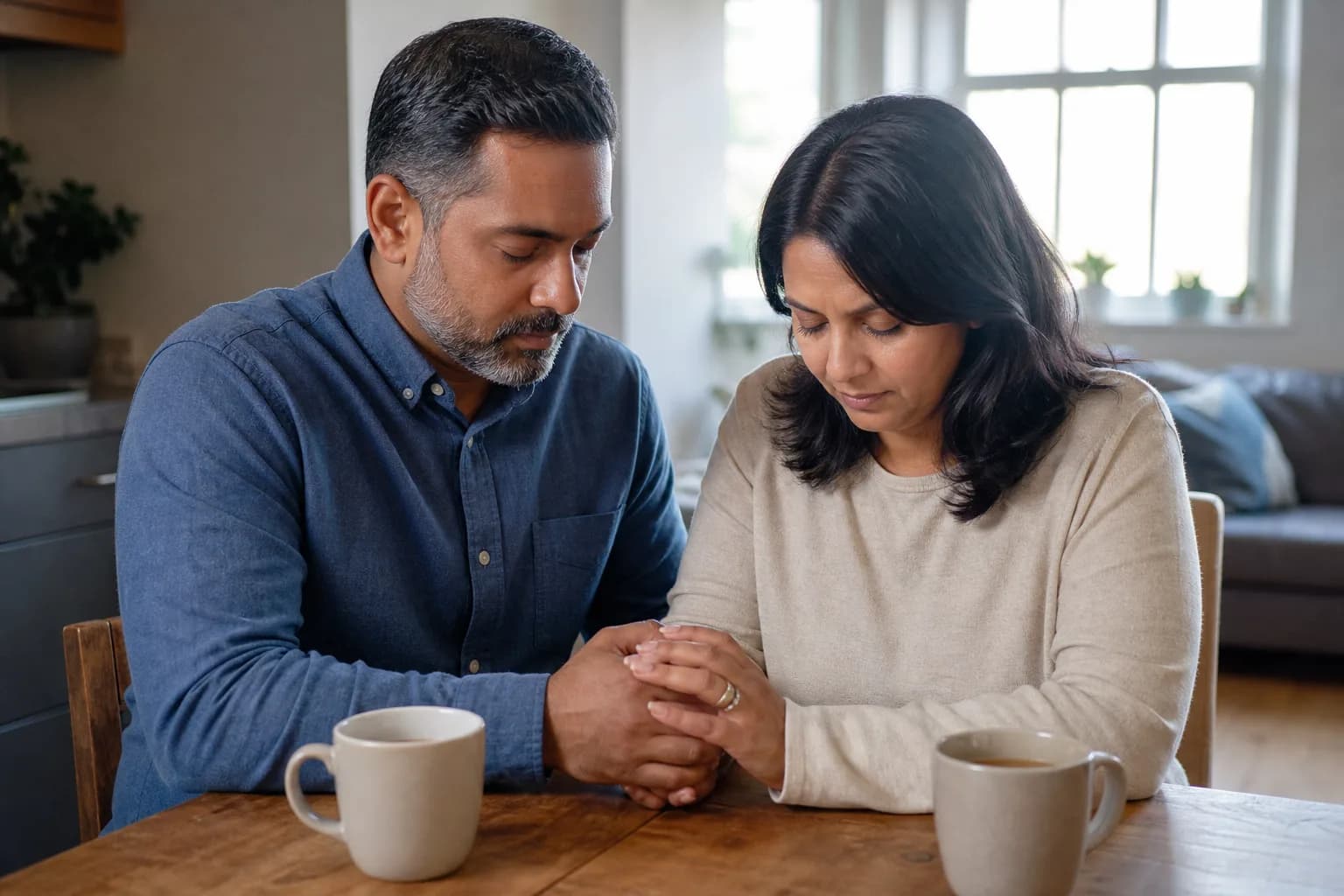
You both believe in prayer. You pray on your own, in the car, in the queue at the school gate. But the two of you praying out loud together? That still feels strange, even after years of marriage.
Maybe you tried once. One of you prayed for four minutes, the other managed a sentence and went quiet. Nobody mentioned it again.
This article gives you a two-minute version you can do tonight, actual sentences to say, and what to do when one of you is keener than the other. No performance required.
Start with two minutes, not twenty
Most couples fail at praying together because they aim too high. A long evening devotional is not the starting point. Two minutes is.
Here is the shape. It works standing in the kitchen, sitting on the end of the bed, or in the car before one of you gets out.
Sit or stand near each other. Phones face down.
Each of you says one thing you are thankful for today. One sentence.
Each of you says one thing you would like God's help with. One sentence.
One of you says, "Lord, thank you. Please help us. Amen."
That is the whole thing. If it takes ninety seconds, you have done it properly.
What to actually say when you dry up
The awkwardness is usually about words. You open your mouth and hear yourself sounding like a bad sermon, so you close it again.
Borrow a sentence instead of composing one. These are enough:
"Lord, thank you for today. It was hard. Please help us tomorrow."
"God, we're worried about Mum. Please look after her."
"Thank you for him. Thank you for her. Amen."
"We don't really know what to pray. Please help anyway."
Short is not lazy. Short is honest, and your spouse can follow it.
Ways to pray that are not praying out loud
If speaking still feels like too much, start somewhere quieter. These count.
Silent hands. Hold hands for one minute, both praying silently. One of you says "Amen" at the end.
Read and stop. Read three verses aloud, then sit quietly for thirty seconds. No commentary.
Written prayers. Say the Lord's Prayer together. Nobody has to improvise.
The list. Keep a note on the fridge of things you are praying for. Read it out. That is a prayer.
Praying at each other's request. "Would you pray for my meeting tomorrow?" Then they do, in one line.
Pick a time you will not have to negotiate
Deciding each night whether to pray is how it stops happening. Attach it to something you already do.
Options that tend to stick: before you turn the light off, after the kettle boils on a Sunday morning, or in the car on the way to church. Choose one. Say it out loud to each other so it is agreed, not assumed.
Two or three times a week is a rhythm. Every night is a rule, and rules get broken and then abandoned.
When one of you is keener than the other
This is the most common version of the problem. One spouse wants to pray together and the other keeps deflecting.
If that is you, the keen one: stop raising it as a spiritual issue. Ask small and ask once.
Try, "Could we pray for thirty seconds before bed on Sundays? I'll keep it short." Then keep it short. If they say no, let it be a no, and keep praying for them on your own without announcing it.
If you are the reluctant one, say why out loud. "I feel stupid praying out loud" is a real reason and a kind thing to tell your spouse. It is far better than avoiding the subject and letting them guess.
When one of you prays much longer
If one of you naturally prays for four minutes and the other for four seconds, agree a cap. One sentence each. It sounds artificial. It fixes the imbalance faster than anything else.
When praying together stirs up an argument
Sometimes prayer gets used as a weapon. "Lord, please help my wife to be more patient with the children." Everyone knows what just happened.
Set one rule: you pray to God, not at each other. If something needs saying to your spouse, say it to their face at a different time.
And if you are still angry from earlier, do not force it. Say, "I don't think I can pray tonight, I'm still upset. Can we try tomorrow?" That is honest, and it protects the practice.
So then, my beloved brethren, let every man be swift to hear, slow to speak, slow to wrath. (James 1:19, NKJV)
Quick to listen, slow to talk. That works for prayer too. If you tend to fill every silence, leave a gap and let your spouse take it.
If prayer or Scripture is being used to control you, frighten you or shut you down, that is not ordinary awkwardness. Please speak to a trusted GP, your church safeguarding lead, or a domestic abuse service in your area.
When the pattern is older than your marriage
Some of us grew up watching prayer done with flourish and volume. Some of us grew up with none at all. Either way, you arrive at your own marriage with a picture of what praying "properly" looks like, and you are quietly failing to match it.
Say that to your spouse. "In my house prayer was always long and loud, and I feel like I can't do it right." Naming it takes most of the power out of it.
Then agree that your marriage gets its own version. Yours might be two sentences in the dark.
Try this tonight
Before the light goes off, turn to your spouse and say: "Can we do thirty seconds? You say one thing you're thankful for, I'll say one, and I'll say amen."
Do it once. Do not review it afterwards. Then put a note in your phone to do the same on Sunday night.
Scripture taken from the New King James Version®. Copyright © 1982 by Thomas Nelson. Used by permission. All rights reserved.
Reflections on covenant marriage from the team behind Cleave.
Keep reading

Different Desire Levels: Talking About Sex Without Shame or Pressure
One of you wants more, the other feels put upon, so neither of you says anything. Here is wording to open the subject kindly this week, and what to do when it lands badly.

What would change in your marriage if you truly had nothing to fear, nothing to hide, and nothing to prove?
Keeping God at the Centre of Your Marriage (in Ordinary Weeks)
Most weeks aren't dramatic — they're logistics. Here's how to build a marriage on shared faith when you're mostly just tired and busy.
A little encouragement, now and then
Join our newsletter for Scripture, gentle marriage encouragement, and new posts. No spam — unsubscribe any time.